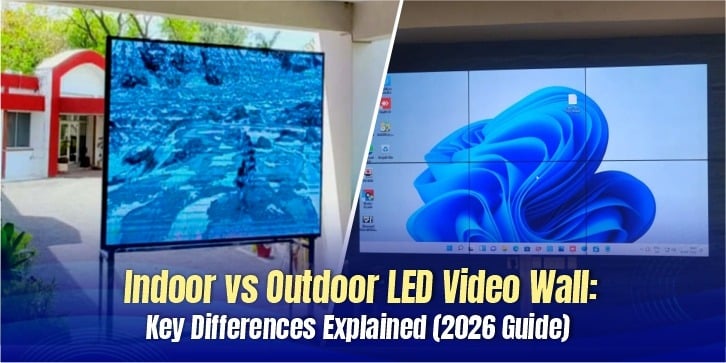
Indoor vs Outdoor LED Video Wall is one of the most common comparisons buyers make before investing in digital display technology. While both solutions use LED panels to create large, seamless displays, their design, brightness, durability, and purpose differ significantly. Understanding these differences helps businesses and smart city planners make the right investment.
In 2026, LED technology has become more advanced, efficient, and scalable. However, choosing between an indoor LED video wall and an outdoor LED video wall still depends on installation environment, audience distance, and content goals. In this guide, we explain the key differences clearly and practically.
What Is an Indoor LED Video Wall?
An indoor LED video wall is designed specifically for controlled environments such as conference rooms, retail stores, auditoriums, shopping malls, control rooms, and corporate offices. Since indoor lighting is stable, these displays focus more on resolution and color precision rather than extreme brightness.
Indoor video walls usually use smaller pixel pitch options, such as P2.5, P2, or even finer configurations. Because viewers stand closer to the screen, high resolution becomes essential. As a result, indoor LED video wall systems deliver sharp images, smooth graphics, and refined text clarity.
Additionally, indoor displays do not require heavy weather protection. This allows for slimmer cabinets and lighter structures, making installation easier and visually elegant.
What Is an Outdoor LED Video Wall?
An outdoor LED video wall is built for open environments where weather conditions, sunlight, dust, and temperature changes affect performance. These displays require high brightness levels to remain visible in direct sunlight.
Unlike indoor systems, outdoor LED video wall solutions use rugged metal cabinets, waterproof protection, and ventilation systems. They are engineered for 24/7 outdoor operation. Because viewers often see these screens from a longer distance, pixel pitch options such as P10, P8, or P6 are commonly used.
Outdoor video walls are typically installed on highways, main roads, railway stations, bus terminals, commercial buildings, and public information zones.
Indoor vs Outdoor LED Video Wall: Brightness Differences
One major difference between indoor LED video wall and outdoor LED video wall systems is brightness.
Indoor displays operate comfortably at lower brightness levels because they are placed in controlled lighting environments. High brightness is unnecessary and could even cause visual discomfort indoors.
In contrast, an outdoor LED video wall must fight against direct sunlight. Therefore, outdoor panels are designed with high-luminance LEDs that ensure visibility throughout the day. Without this brightness capability, content would appear faded or unreadable.
Indoor vs Outdoor LED Video Wall: Pixel Pitch and Viewing Distance
Another critical difference lies in pixel pitch selection.
Indoor LED video wall solutions use smaller pixel pitch configurations to provide detailed resolution for close viewing. Since audiences stand only a few meters away, image sharpness becomes the priority.
On the other hand, an outdoor LED video wall generally uses larger pixel pitch options. This is because viewers are usually at a distance, such as drivers on highways or pedestrians across roads. A larger pitch reduces cost while maintaining visibility at long range.
Choosing the correct pixel pitch ensures both cost efficiency and optimal performance.
Indoor vs Outdoor LED Video Wall: Durability and Build Quality
Indoor LED video wall systems prioritize lightweight cabinets and seamless design aesthetics. Since they are protected from weather exposure, they do not require heavy protective housing.
However, an outdoor LED video wall must withstand rain, heat, humidity, dust, and pollution. These systems include weatherproof cabinets, cooling mechanisms, and sealed electronic components.
Because of these design differences, outdoor installations are generally more robust and structurally reinforced.
Indoor vs Outdoor LED Video Wall: Installation and Mounting
Indoor installations usually involve wall mounting or structured framing inside commercial spaces. These setups focus on design appeal and interior integration.
In comparison, outdoor LED video wall installations support wall mounting, pole mounting, and even movable stands. Structural strength and safety compliance become crucial factors in outdoor environments.
Advance Tech India provides flexible mounting solutions depending on project requirements.
Product Overview: LED Video Wall Solutions by Advance Tech India
Advance Tech India delivers both indoor LED video wall and outdoor LED video wall solutions designed for performance, scalability, and long-term reliability.
Pixel Pitch Options
Displays are available in multiple pixel pitch configurations, including P10, P8, P6, P4, and P2. 5. This ensures clarity based on viewing distance and installation type.
Standard and Custom Sizes
Standard sizes include formats such as 3 by 2 feet, 6 by 4 feet, 8 by 6 feet, and 10 by 8 feet. However, complete customization is possible because of the modular LED structure.
Mounting Arrangements
The systems support wall mounting, pole mounting, and movable stand options, depending on site conditions.
Smart Video Wall Controller
Each LED video wall comes with an advanced controller and software system that allows users to upload videos, images, and text layouts. Content can be managed through LAN, GSM, or USB connectivity.
These features ensure operational flexibility and professional performance.
Indoor vs Outdoor LED Video Wall: Cost and ROI
Indoor installations often cost less because they do not require heavy protective cabinets. However, they may use finer pixel pitch, which can increase resolution cost.
Outdoor LED video wall systems may require higher initial investment due to brightness capability and rugged build. However, they generate strong advertising value and public communication impact.
Over time, both systems deliver a high return on investment when chosen correctly.
Which One Should You Choose in 2026?
If your requirement is for conference halls, showrooms, or control rooms, an indoor LED video wall is ideal.
If your project involves highways, public areas, smart city communication, or commercial outdoor advertising, then an outdoor LED video wall is the correct choice.
Understanding the difference between indoor vs. outdoor LED video walls ensures that your investment aligns with your business objectives.
Internal & External Resources
For further insights on LED standards and smart city digital infrastructure, you may explore global LED display guidelines and smart infrastructure reports from recognized industry bodies.
You can also explore more display solutions offered by Advance Tech India for indoor and outdoor digital signage systems.
Conclusion
Indoor vs. outdoor LED video walls is not just a technical comparison. It is a strategic decision. Indoor systems focus on resolution and aesthetics, while outdoor systems emphasize brightness and durability.
By evaluating location, viewing distance, pixel pitch, and installation needs, you can select the right LED video wall for 2026 and beyond.
With quality solutions from Advance Tech India, both indoor LED video wall and outdoor LED video wall systems deliver reliable performance, scalability, and long-term value.