Businesses today are focusing on creating engaging experiences rather than simply displaying information. Whether it is a retail showroom, educational institution, corporate office, museum, or visitor center, organizations are looking for smarter ways to interact with customers and share information effectively.
This shift has increased the demand for interactive display technologies across India. Two solutions that are often compared are digital touch tables and interactive kiosks. While both use touchscreen technology, they serve different business purposes and deliver different user experiences.
Choosing the right solution depends on how users interact with content and what outcomes a business expects to achieve. Understanding the strengths of both technologies can help organizations make a more informed investment decision.
The Growing Demand for Interactive Business Technologies
Customer expectations have changed significantly over the past few years. People now expect fast access to information, interactive experiences, and modern digital environments.
As a result, businesses are investing in solutions that improve communication and engagement while supporting their digital transformation goals. Interactive displays have become valuable tools because they encourage participation and help users connect with information more effectively.
Industries such as retail, education, hospitality, real estate, healthcare, and corporate services are increasingly adopting these technologies to improve customer experiences and operational efficiency.
Understanding Digital Touch Tables
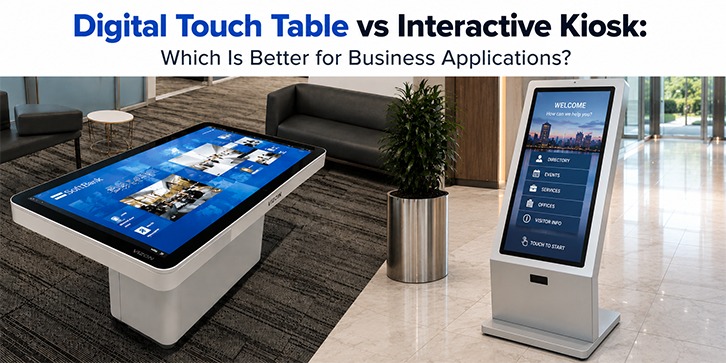
Digital touch tables are interactive display systems designed for collaboration and engagement. Unlike traditional screens, they allow multiple users to interact with content simultaneously.
These solutions are commonly used when businesses want people to explore information, compare products, participate in discussions, or collaborate on projects.
Organisations often implement interactive touch tables in:
- Retail showrooms
- Educational institutions
- Corporate meeting spaces
- Museums and exhibitions
- Real estate experience centres
- Innovation and visitor centres
The ability to support group interaction makes these solutions highly effective in environments where engagement and collaboration are important.
Understanding Interactive Kiosks
They are self-service systems designed to help users access information or complete specific tasks independently.
These solutions are typically placed in public or commercial environments where visitors need quick and convenient access to services.
Common applications include:
- Visitor registration
- Information lookup
- Wayfinding and navigation
- Self-ordering systems
- Appointment management
- Ticket booking
Businesses often choose these systems because they improve convenience while reducing the need for staff assistance.
Digital Touch Tables vs Interactive Kiosks: Understanding the Core Difference
Although both technologies use touchscreen functionality, they are designed for different user experiences.
Digital touch tables are built to encourage interaction, collaboration, and exploration. Users can gather around the display, engage with content together, and participate in discussions or presentations.
Interactive kiosks, on the other hand, are designed for individual users. Their primary purpose is to help people quickly complete tasks or access information without assistance.
Businesses focused on customer engagement often prefer collaborative display solutions, while organisations looking to automate services frequently choose self-service kiosk systems.
Which Solution Works Better for Retail Businesses?
Retail businesses are becoming increasingly experience-driven. Customers want more than just product displays; they want interactive experiences that help them make informed decisions.
Many retailers use digital touch tables to showcase product catalogs, compare features, display promotional content, and create engaging shopping experiences. These solutions encourage customers to spend more time interacting with products and brand information.
By comparison, interactive kiosks are commonly used for product searches, store navigation, and customer assistance. They improve convenience but generally do not offer the same level of interaction.
For businesses looking to create a premium customer experience, collaborative touchscreen solutions often provide greater long-term value.
Which Solution Is Better for Educational Institutions?
Educational institutions across India are investing heavily in interactive learning technologies.
Digital touch tables support collaborative learning by allowing students and educators to engage with content together. They are widely used in smart classrooms, training centers, and learning environments where participation is encouraged.
Meanwhile, interactive kiosks are typically used for administrative purposes such as visitor management, campus navigation, information sharing, and student registration.
When the goal is to improve learning experiences and classroom engagement, interactive collaboration systems generally offer greater benefits.
Real-World Business Applications
The adoption of interactive display technologies continues to grow across various industries.
Retail and Showrooms
Businesses use touchscreen collaboration systems to create engaging product demonstrations and customer experiences.
Corporate Offices
Modern workplaces use these technologies for presentations, brainstorming sessions, project discussions, and team collaboration.
Museums and Visitor Centres
Interactive displays help visitors explore exhibits, multimedia content, and educational information more effectively.
Educational Institutions
Schools and universities use interactive learning technologies to support participation and improve engagement.
Real Estate Industry
Developers use these systems to present project information, property layouts, and virtual walkthroughs in an engaging format.
These examples demonstrate how businesses are using interactive technologies to improve communication and user experiences.
Why Businesses in India Are Investing in Interactive Technologies
Organisations today understand that engagement plays a crucial role in customer satisfaction and brand perception.
Interactive technologies help businesses:
- Improve user engagement
- Deliver information more effectively
- Enhance customer experiences
- Support digital transformation initiatives
- Create modern and professional environments
Many organisations report higher participation levels when using interactive displays compared to traditional communication methods.
This is one of the key reasons why businesses across India continue to invest in advanced touchscreen solutions.
How Advancetech India Supports Modern Business Communication
Advancetech India provides advanced interactive display solutions for businesses, educational institutions, and commercial environments across Punjab and India.
From collaborative touchscreen systems to Interactive Kiosks, the company helps organizations create engaging experiences that improve communication and user interaction.
By offering customized solutions tailored to specific industry requirements, Advancetech India supports businesses in building modern and technology-driven environments.
Which Option Should You Choose?
The right choice depends entirely on your business goals.
If your organization wants to improve collaboration, encourage engagement, and create immersive user experiences, digital touch tables can be an excellent investment.
If your focus is on self-service operations, visitor assistance, information access, and process automation, interactive kiosks may be the more practical solution.
Both technologies offer unique benefits, but businesses that prioritize interaction and customer engagement often achieve stronger results with collaborative display solutions.
Conclusion
Interactive technologies are transforming the way businesses communicate with customers, visitors, and employees. While interactive kiosks remain highly effective for self-service applications, digital touch tables offer a more engaging and collaborative experience.
From retail showrooms and educational institutions to corporate offices and visitor centers, businesses are increasingly adopting interactive solutions to improve communication and strengthen customer engagement.
As digital transformation continues across India, investing in the right interactive technology can help organizations create memorable experiences, improve operational efficiency, and stay ahead in an increasingly competitive market.
FAQs
What are digital touch tables used for?
Digital touch tables are commonly used for collaboration, presentations, product demonstrations, educational activities, and customer engagement.
Where are interactive kiosks commonly installed?
Interactive kiosks are widely used in shopping malls, hospitals, airports, hotels, educational institutions, and government facilities.
Which solution is better for customer engagement?
Businesses looking to create interactive and collaborative experiences often find Digital Touch Tables more effective, while Interactive Kiosks are better suited for self-service applications.