

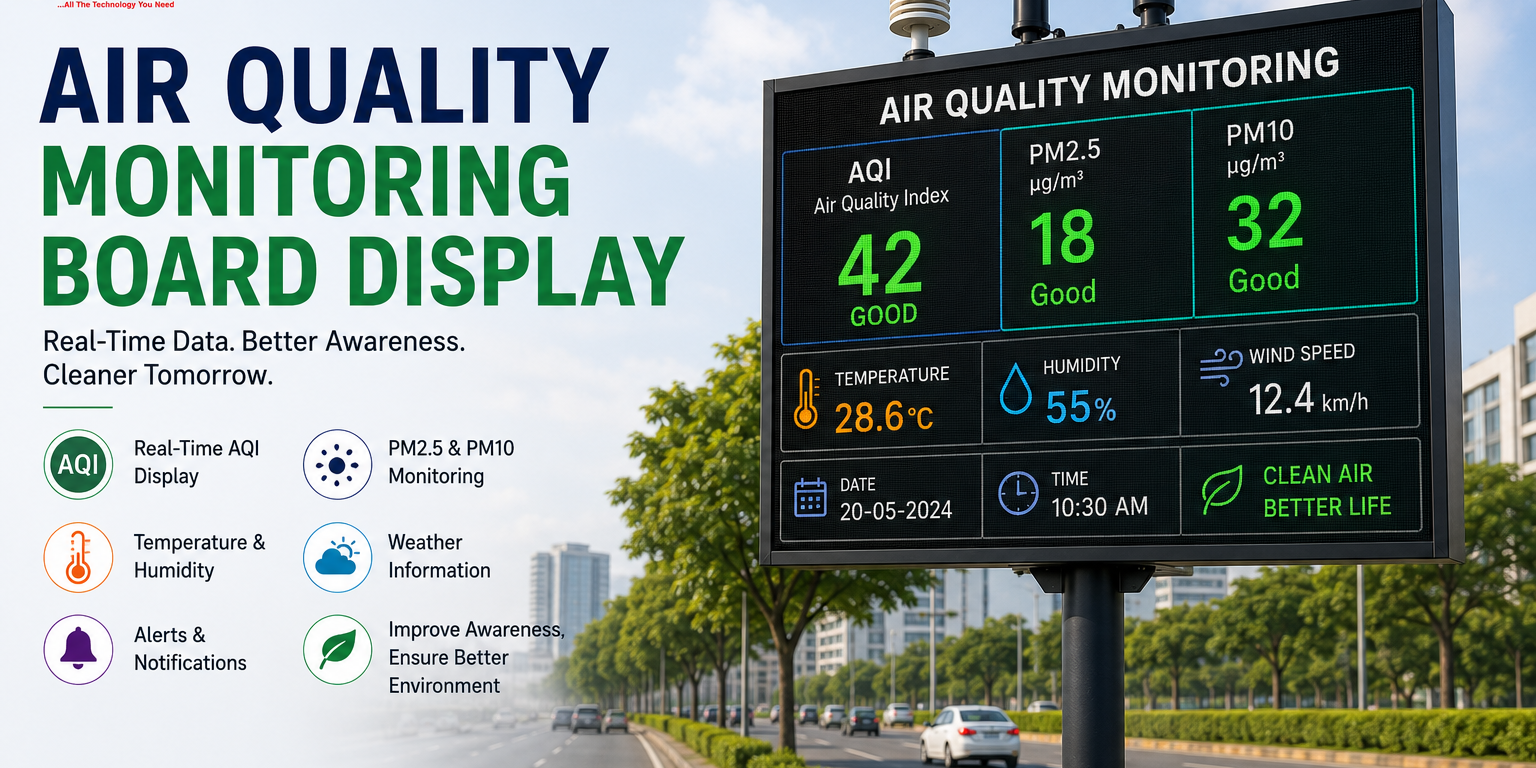
Air pollution data is most useful when people can actually see and understand it. A dashboard hidden inside a website or monitoring application may provide valuable information, but a clearly visible Air Quality Monitoring Board Display can bring that information directly to residents, employees, visitors, commuters, and decision-makers.
These displays combine air-quality sensing and data visualization to present information such as AQI, PM2.5, PM10, temperature, humidity, and other environmental parameters in a highly visible format. They can be used in smart cities, industrial areas, campuses, public spaces, commercial facilities, and other locations where environmental awareness matters.
The World Health Organization identifies particulate matter (PM2.5 and PM10), ozone, nitrogen dioxide, sulfur dioxide, and carbon monoxide among the key pollutants for air-quality assessment. Its 2021 guidelines also emphasize that health risks can occur at lower pollutant concentrations than previously understood.
What Is an Air Quality Monitoring Board Display?
An Air Quality Monitoring Board Display is a digital information board designed to present air-quality measurements in an easy-to-read visual format.
Depending on the system configuration, the display can show information such as:
- Air Quality Index (AQI)
- PM2.5 concentration
- PM10 concentration
- Temperature
- Relative humidity
- Other selected environmental parameters
- Date and time
- Status messages or public awareness information
The basic concept is straightforward: sensors collect environmental measurements, a monitoring system processes the data, and a digital display communicates the results to people in the surrounding area.
This makes the technology useful not only for monitoring but also for public communication and environmental awareness.
Why Is Real-Time Air Quality Display Important?
Collecting air-quality data is only one part of environmental monitoring. The next challenge is communicating that information effectively.
A visible display can help organizations make air-quality information easier to access. Instead of requiring people to open an application or search for a monitoring station online, the information can be presented at the location where it matters.
This can support:
- Public awareness
- Environmental communication
- Workplace awareness
- Smart-city initiatives
- Industrial monitoring
- Institutional sustainability programs
- Data-driven operational decisions
Research has also highlighted the value of making air-quality information more visible to the public rather than leaving it accessible only through specialized platforms.
What Information Should an Air Quality Monitoring Board Display Show?
The right parameters depend on the application, location, monitoring objectives, and sensor configuration.
AQI
AQI provides a simplified way of communicating air-quality conditions. A display can present the current index prominently so that users can understand the overall status without interpreting several individual measurements.
PM2.5
PM2.5 refers to fine particulate matter with an aerodynamic diameter of 2.5 micrometres or smaller. It is one of the major pollutants considered in international air-quality guidelines.
PM10
PM10 represents particulate matter with an aerodynamic diameter of 10 micrometres or smaller and is another important parameter for air-quality monitoring.
Temperature and Humidity
Including environmental conditions alongside pollution measurements can provide useful context and support broader environmental monitoring.
Additional Parameters
Depending on the project, organizations may require additional pollutants or environmental measurements. The display should therefore be selected according to the actual monitoring requirements rather than simply choosing the largest screen.
Where Can Air Quality Monitoring Board Displays Be Used?
Smart Cities
Municipal and smart-city projects can use visible air-quality displays at public locations to communicate environmental conditions and encourage awareness.
Potential locations include:
- Major roads
- Public squares
- Government facilities
- Transport areas
- Smart-city command environments
- High-footfall public spaces
Industrial Areas
Industries can use environmental displays to communicate monitored conditions around facilities or designated areas.
A visible display can complement a broader environmental monitoring system by making selected measurements easier to see.
Educational Institutions
Schools, colleges, universities, and research campuses can use air-quality displays as educational and awareness tools.
Students can see environmental information in real time, turning an otherwise abstract concept into something visible and understandable.
Corporate Campuses
Large corporate campuses can use environmental displays to communicate sustainability and air-quality information to employees and visitors.
Public and Commercial Spaces
Shopping areas, exhibition spaces, parks, hospitals, and other public-facing locations can use digital boards to communicate environmental information where visibility is important.
What Are the Benefits of an Air Quality Monitoring Board Display?
Makes Environmental Data Visible
One of the biggest advantages is straightforward: people can see the information.
A large, readable display can communicate selected environmental measurements without requiring users to access a separate digital platform.
Supports Public Awareness
Visible information can encourage people to pay greater attention to local environmental conditions.
Enables Faster Interpretation
Displaying the most important information prominently helps users understand current conditions quickly.
Supports Data-Driven Decisions
For organizations operating industrial facilities, campuses, or public infrastructure, environmental data can contribute to operational planning and response strategies.
Strengthens Smart-City Communication
Digital environmental displays can become part of a wider smart-city infrastructure in which sensors, analytics platforms, dashboards, and public displays work together.
How Does an Air Quality Monitoring Board Display Work?
A typical deployment can be understood as four stages.
Step 1: Environmental Sensing
Sensors measure selected pollutants and environmental parameters.
Step 2: Data Processing
The monitoring system receives and processes the sensor readings.
Step 3: Data Communication
Measurements are transmitted to the display or associated monitoring platform through the selected communication architecture.
Step 4: Visual Presentation
The board presents the information using large-format digital graphics, numerical readings, status indicators, or other visual elements.
The exact architecture depends on the project’s sensor selection, connectivity, software, display technology, and monitoring requirements.
How Should You Choose an Air Quality Monitoring Board Display?
Buying the display should not be the first step. Start by defining the monitoring objective.
- Identify the Location
Determine whether the board will be installed indoors or outdoors.
Outdoor installations require particular attention to environmental exposure, brightness, enclosure protection, mounting, and visibility.
- Define the Required Parameters
Decide which pollutants and environmental conditions need to be monitored.
Do not pay for unnecessary sensors simply because they are available. Match the sensor configuration to the actual application.
- Consider Viewing Distance
The display size and resolution should be appropriate for the distance from which people will read the information.
A board beside a road has different requirements from a display installed inside a building lobby.
- Prioritize Readability
An outdoor display should remain readable under changing daylight conditions. Font size, brightness, contrast, layout, and viewing angle all matter.
- Plan Connectivity
Determine how data will reach the display. Depending on the deployment, this may involve wired networking, wireless communication, cellular connectivity, or another suitable architecture.
- Consider Maintenance
Ask about sensor maintenance, calibration requirements, display servicing, software updates, and technical support before finalizing the system.
What Is the Difference Between an Air Quality Monitor and an Air Quality Display Board?
An air-quality monitor primarily focuses on measuring and recording environmental conditions.
An Air Quality Monitoring Board Display adds a public-facing communication layer by presenting selected measurements in a visible format.
In many projects, both functions work together:
Sensors → Monitoring System → Data Processing → Digital Display
This distinction is important when planning a project because measurement accuracy and display visibility are separate considerations.
How Can Organizations Get Better Results from an Air Quality Display?
A technically capable display can still fail if the information is difficult to understand.
Keep the Primary Information Prominent
AQI or the project’s primary indicator should be easy to identify immediately.
Avoid Information Overload
Do not fill the board with every available measurement. Display the information that matters most to the intended audience.
Use Consistent Units
Measurements should use clearly labelled and appropriate units.
Make Updates Easy
If the system supports remote content or configuration management, organizations can update informational messages without physically accessing the display.
Combine Monitoring With Action
Where appropriate, connect displayed information to organizational procedures. For example, an industrial facility may define internal actions when monitored conditions cross predetermined thresholds.
Why Is Sensor Quality Important?
The display can only communicate the quality of the data it receives.
For this reason, project planning should consider:
- Sensor suitability
- Calibration
- Installation environment
- Maintenance
- Data validation
- Environmental conditions
- Monitoring objectives
The WHO’s air-quality guidelines provide health-based guideline levels for several major pollutants, but those guidelines are not themselves legally binding standards. Organizations should therefore distinguish between health guidance, applicable regulatory requirements, and the specific purpose of their monitoring system.
Why Choose AdrTech India for an Air Quality Monitoring Board Display?
AdrTech India’s Air Quality Monitoring Board Display is designed to make environmental information visible through a digital display solution.
For organizations evaluating such a system, the important considerations are not only the screen but also the complete deployment: monitoring requirements, sensor configuration, data communication, display visibility, installation environment, and ongoing support.
Frequently Asked Questions
What is an Air Quality Monitoring Board Display?
It is a digital display system that presents air-quality measurements such as AQI and particulate-matter readings in a highly visible format.
What parameters can it display?
Depending on the system configuration, it can display AQI, PM2.5, PM10, temperature, humidity, and other selected environmental parameters.
Where are air-quality display boards commonly installed?
They can be used in smart cities, industrial facilities, educational campuses, corporate premises, public spaces, and other locations where visible environmental information is useful.
Can an Air Quality Monitoring Board Display be used outdoors?
Outdoor deployment is possible when the selected display and enclosure are appropriate for the installation environment. Brightness, weather exposure, mounting, and visibility should be considered during system design.
Is an Air Quality Display Board the same as an AQI monitoring station?
Not necessarily. A monitoring station focuses on environmental measurement and data collection, while a display board focuses on communicating selected measurements visually. A project can combine both functions.
Why are PM2.5 and PM10 important?
PM2.5 and PM10 are major particulate pollutants considered in air-quality assessment. WHO’s 2021 guidelines specifically address both pollutants because of their relevance to health.
Can the display show information other than air-quality data?
The available content depends on the system design. A project may incorporate supporting information, awareness messages, environmental data, or other content where appropriate.
Conclusion
An Air Quality Monitoring Board Display turns environmental measurements into information that people can see and understand.
For smart cities, industries, campuses, public spaces, and organizations focused on environmental awareness, the right system can connect sensing, data processing, and public communication in one practical deployment.
The key is to look beyond the screen itself. A successful project should consider the required pollutants, sensor quality, installation location, viewing distance, connectivity, readability, maintenance, and the purpose of the information being displayed.
When these elements are planned together, an Air Quality Monitoring Board Display can become a valuable part of a modern environmental monitoring and communication strategy.
