

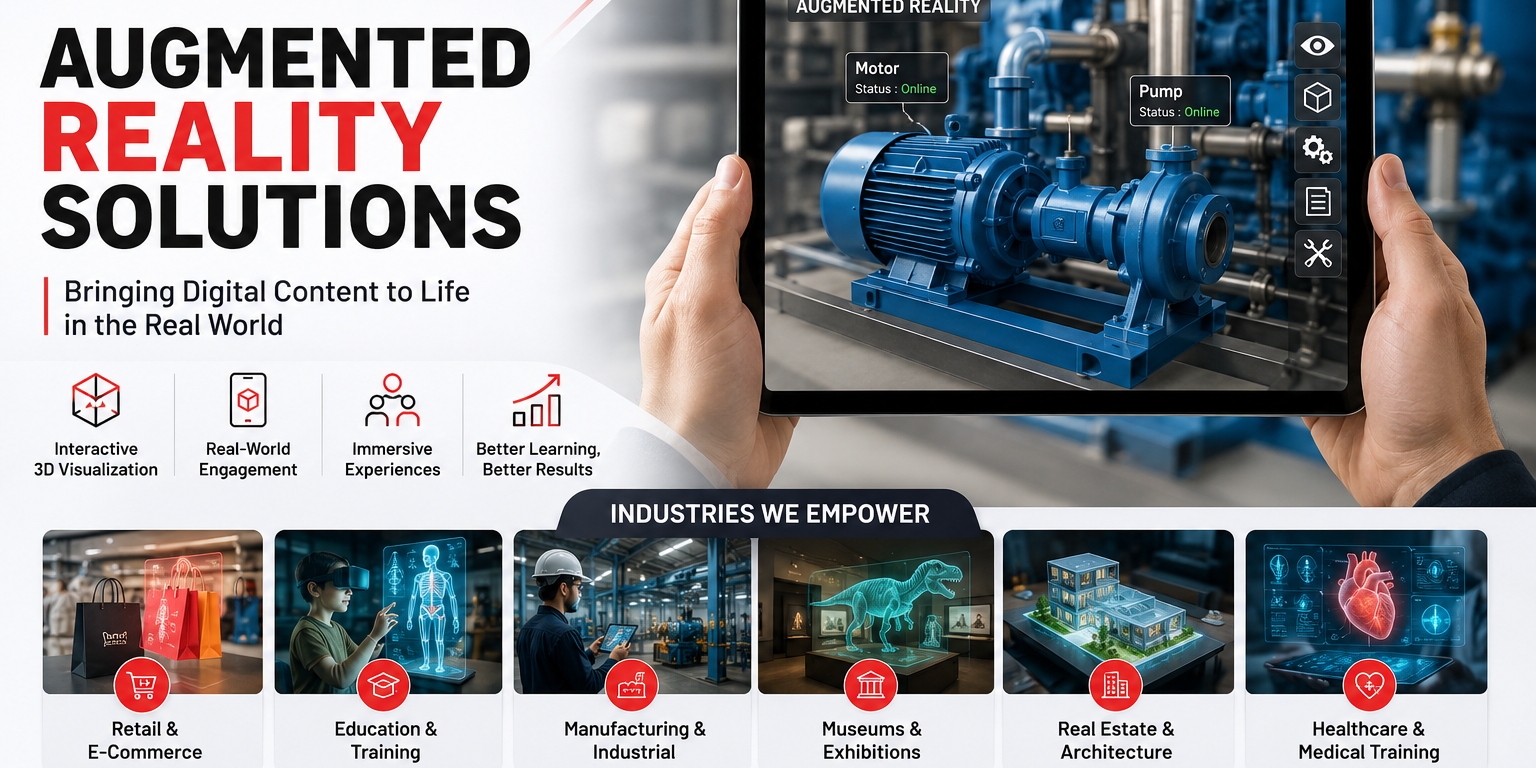
Digital transformation is reshaping how businesses interact with customers, train employees, and showcase products. One technology leading this change is Augmented Reality (AR). Unlike traditional presentations or static displays, Augmented Reality Solutions combine digital content with the real world, creating immersive and interactive experiences that improve engagement and decision-making.
From retail stores and manufacturing plants to educational institutions and museums, organizations across India are adopting AR to enhance productivity, simplify complex information, and create memorable customer experiences.
In this guide, we’ll explore what Augmented Reality Solutions are, their applications, benefits, implementation tips, and how to choose the right AR solution for your organization.
What Are Augmented Reality Solutions?
Augmented Reality Solutions use smartphones, tablets, smart glasses, or interactive displays to overlay digital information onto the physical environment.
Unlike Virtual Reality (VR), which creates a completely virtual environment, AR enhances the real world by adding digital objects, animations, instructions, or 3D models that users can interact with in real time.
Businesses use AR to:
- Visualize products before purchase
- Deliver interactive training
- Simplify maintenance procedures
- Enhance museum exhibits
- Improve classroom learning
- Create engaging marketing campaigns
Why Are Businesses Investing in Augmented Reality Solutions?
Customer expectations are changing rapidly. People want interactive experiences instead of static information.
AR solutions help businesses:
- Increase customer engagement
- Improve product understanding
- Reduce training time
- Support remote assistance
- Improve decision-making
- Increase sales conversions
- Differentiate from competitors
As AR technology becomes more affordable, businesses of every size can benefit from immersive digital experiences.
Which Industries Benefit Most from Augmented Reality?
Retail and Experience Centres
Retailers use AR to allow customers to:
- View products in 3D
- Compare product variants
- Explore product features
- Visualize furniture or equipment before purchasing
Interactive product demonstrations increase customer confidence and reduce buying hesitation.
Education and Smart Classrooms
Educational institutions use AR to transform traditional learning into immersive experiences.
Students can:
- Explore 3D scientific models
- Study human anatomy
- Visualize engineering components
- Learn history through interactive content
AR makes learning more engaging while improving knowledge retention.
Manufacturing and Industrial Training
Manufacturers use AR for:
- Equipment maintenance
- Machine assembly guidance
- Employee onboarding
- Safety training
- Remote technical assistance
Interactive instructions reduce human error and improve operational efficiency.
Museums and Cultural Centres
Museums increasingly use Augmented Reality to:
- Bring historical artifacts to life
- Display virtual reconstructions
- Provide multilingual information
- Deliver interactive storytelling
Visitors enjoy a richer and more memorable learning experience.
Healthcare
Healthcare professionals use AR for:
- Medical training
- Surgical visualization
- Patient education
- Equipment guidance
AR enables healthcare providers to communicate complex information more effectively.
What Are the Key Benefits of Augmented Reality Solutions?
Better Customer Engagement
Interactive experiences naturally attract more attention than static displays.
Improved Learning and Training
Employees and students understand complex concepts faster through visual demonstrations.
Higher Productivity
Step-by-step AR instructions reduce errors and improve workflow efficiency.
Reduced Operational Costs
Remote guidance and digital visualization reduce travel, printing, and training expenses.
Stronger Brand Experience
Innovative technologies position organizations as modern, customer-focused businesses.
How Do Augmented Reality Solutions Work?
Most AR systems follow a simple process:
Step 1: Capture the Environment
A smartphone, tablet, or camera scans the surrounding area.
Step 2: Process the Data
The AR software identifies surfaces, objects, or markers.
Step 3: Display Digital Content
The application overlays interactive 3D models, videos, animations, or instructions onto the real-world view.
Step 4: User Interaction
Users rotate, zoom, move, and interact with digital objects using touch gestures or motion controls.
How to Choose the Right Augmented Reality Solution
Before investing, consider the following:
Define Your Objective
Determine whether the solution is for:
- Marketing
- Product demonstrations
- Training
- Education
- Maintenance
- Customer engagement
Select the Right Hardware
Choose devices based on your application:
- Smartphones
- Tablets
- Interactive kiosks
- Smart glasses
- Interactive flat panels
Focus on Content Quality
The success of an AR solution depends on engaging, accurate, and regularly updated digital content.
Ensure Easy Integration
Choose solutions that integrate with your existing website, CRM, ERP, or learning management systems where applicable.
Partner with an Experienced Provider
A reliable implementation partner ensures proper planning, deployment, customization, and ongoing support.
Why Choose AdrTech India for Augmented Reality Solutions?
AdrTech India develops customized Augmented Reality Solutions for businesses, educational institutions, museums, manufacturing industries, and government organizations.
Our solutions help organizations create immersive experiences that improve learning, customer engagement, and operational efficiency.
Whether you need interactive product visualization, educational content, industrial training, or digital storytelling, our team delivers solutions tailored to your objectives.
Frequently Asked Questions
What are Augmented Reality Solutions?
Augmented Reality Solutions overlay digital content such as 3D models, videos, or animations onto the real world using smartphones, tablets, smart glasses, or interactive displays.
Which industries use AR solutions?
Retail, manufacturing, education, healthcare, museums, automotive, real estate, tourism, and government organizations widely use Augmented Reality.
Is Augmented Reality expensive?
The cost depends on the complexity of the application, hardware requirements, and customization. Many businesses start with mobile-based AR before expanding to enterprise deployments.
Can AR improve employee training?
Yes. AR provides interactive, visual instructions that improve learning outcomes, reduce errors, and shorten training time.
What devices support Augmented Reality?
Most AR applications work on smartphones, tablets, interactive kiosks, smart glasses, and compatible web browsers.
What is the difference between AR and VR?
Augmented Reality enhances the real world by adding digital content, while Virtual Reality creates a fully immersive virtual environment that replaces the real world.
Final Thoughts
Augmented Reality Solutions are no longer limited to entertainment or gaming. They have become practical business tools that improve customer engagement, simplify training, enhance education, and support smarter decision-making.
Organizations that embrace AR today are better positioned to deliver immersive experiences, streamline operations, and stand out in an increasingly competitive market.
If you’re planning to implement interactive technologies in your organization, investing in a professional Augmented Reality Solution can help future-proof your business while creating meaningful digital experiences for your customers and employees.
