Outdoor LED video wall technology plays an important role in modern digital communication systems. Businesses and public organizations use both indoor LED video wall and outdoor LED video wall displays to share information effectively.
Businesses, advertisers, and public institutions rely on LED video walls to deliver messages effectively. While indoor displays prioritize high resolution and close viewing clarity, outdoor displays focus on brightness, durability, and long-distance visibility. Knowing these differences helps buyers select the right display system for their specific needs.
Display Environment and Structural Design
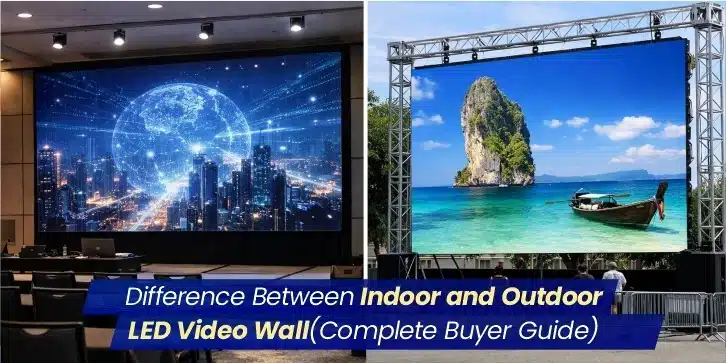
One of the most important differences between an indoor LED video wall and an outdoor LED video wall lies in the environment where the display operates. Indoor LED displays are installed in controlled environments such as conference halls, shopping malls, control rooms, and exhibition centers. Because these spaces are protected from harsh weather conditions, indoor displays do not require heavy protective structures.
In contrast, an outdoor LED video wall must operate in challenging outdoor conditions. These displays face direct sunlight, dust, rain, and temperature fluctuations. Therefore, outdoor LED systems are built with rugged cabinets and weather-resistant components. Their structural design ensures that the display continues functioning reliably in open environments.
Brightness Performance and Visibility
Brightness is another major factor that differentiates indoor and outdoor LED displays. Indoor LED video walls typically operate at moderate brightness levels because they are used in controlled lighting environments. The goal is to provide clear and comfortable viewing without causing eye strain.
However, an outdoor LED video wall must remain visible even in strong daylight. For this reason, outdoor displays are designed with significantly higher brightness levels. This ensures that content remains sharp and readable even under direct sunlight. As a result, outdoor LED video walls are ideal for high-visibility locations such as highways, stadiums, and public squares.
Pixel Pitch and Viewing Distance
Pixel pitch refers to the distance between two LED pixels, and it directly affects the image clarity and viewing distance of a display. Indoor LED video walls usually feature smaller pixel pitch options, allowing them to produce highly detailed visuals that look sharp even at close viewing distances.
Outdoor LED video walls typically use larger pixel pitch configurations because viewers are often located farther away from the screen. Larger pixel pitch allows the display to maintain visibility and readability over longer distances. Selecting the correct pixel pitch ensures that the screen delivers clear visuals while maintaining cost efficiency.
Outdoor LED video wall solutions are commonly available in multiple pixel pitch options, including P10, P8, P6, P4, and P2.5. Each option is suitable for a different viewing distance and installation requirement.
Installation Flexibility and Mounting Options
The installation process also differs between indoor and outdoor LED displays. Indoor LED video walls are usually mounted on interior walls or integrated into architectural structures. Controlled indoor environments make installation relatively straightforward and eliminate the need for heavy support systems.
Outdoor LED video wall installations require stronger mounting arrangements. These displays can be mounted on building facades, roadside poles, or dedicated structures depending on the location. Flexible mounting options such as wall mounting, pole mounting, and movable stand setups allow the display to adapt to different outdoor environments.
Product Details: Outdoor LED Video Wall Display Solutions by Advance Tech India
Advance Tech India provides high-quality outdoor LED video wall solutions designed for long-term outdoor performance. These displays combine durability, high brightness, and flexible configuration to support various commercial and public applications.
We design the outdoor LED video wall systems to function in demanding environments while maintaining consistent visual quality. Their robust construction ensures stable operation even in extreme weather conditions.
The displays are available with multiple pixel pitch options, such as P10, P8, P6, P4, and P2.5. This variety allows businesses and infrastructure projects to choose the right resolution based on viewing distance and installation location.
In terms of mounting flexibility, the outdoor LED video wall supports ceiling mounting, pole mounting, and movable stand configurations. This makes it suitable for building exteriors, highways, public areas, and event installations.
Standard display sizes include formats such as 3 by 2 feet, 6 by 4 feet, 8 by 6 feet, and 10 by 8 feet. Because the system uses modular LED panels, additional customization is also possible to create larger display walls when required.
Each system also includes a video wall controller and intelligent software that allows users to upload images, videos, and scrolling text. Content can be managed using multiple connectivity options such as GSM, LAN, or USB, making updates quick and efficient.
Application Areas for Indoor and Outdoor LED Displays
Indoor LED video walls are widely used in corporate offices, shopping malls, exhibition halls, and control rooms. These environments require high-resolution displays that deliver detailed visuals for presentations, advertising, and monitoring systems.
Outdoor LED video walls, on the other hand, are used in locations where high visibility is essential. These include railway stations, bus stands, highways, sports stadiums, and city centers. In such areas, large digital displays help communicate advertisements, announcements, and public information to large audiences.
Because of their durability and brightness, outdoor LED video walls remain effective communication tools in busy public environments.
Maintenance and Long-Term Performance
Maintenance requirements also differ between indoor and outdoor displays. Indoor LED video walls generally require less maintenance because they operate in protected environments with stable temperatures.
Outdoor LED video walls require more robust maintenance planning due to environmental exposure, including factors such as weather conditions, dust, and temperature fluctuations, which can affect their performance and longevity. However, modern outdoor displays are designed with protective cabinets and efficient cooling systems to ensure reliable long-term operation. With proper maintenance and installation, these displays can perform effectively for many years.
Choosing the Right LED Video Wall for Your Project
The location and use of the display are key to choosing the right LED video wall. Indoor LED displays are the best choice for environments where viewers are close to the screen and where lighting conditions remain controlled.
Outdoor LED video walls are ideal for large public spaces where visibility from long distances is required. Their rugged design and high brightness make them suitable for outdoor advertising, smart city communication, and large-scale public displays.
By carefully considering factors such as viewing distance, environment, brightness, and installation requirements, buyers can make informed decisions that maximize their investment.
Conclusion
Understanding the difference between an indoor LED video wall and an outdoor LED video wall is essential before making a purchase decision. Each display type is designed to serve different purposes and environments.
Indoor displays provide high-resolution visuals for close viewing environments, while outdoor LED video walls offer brightness, durability, and large-scale visibility for open spaces. By selecting the right display solution, businesses and organizations can improve communication, enhance brand visibility, and deliver impactful visual experiences.
With reliable solutions from Advance Tech India, both indoor and outdoor LED display projects can achieve strong performance and long-term value.