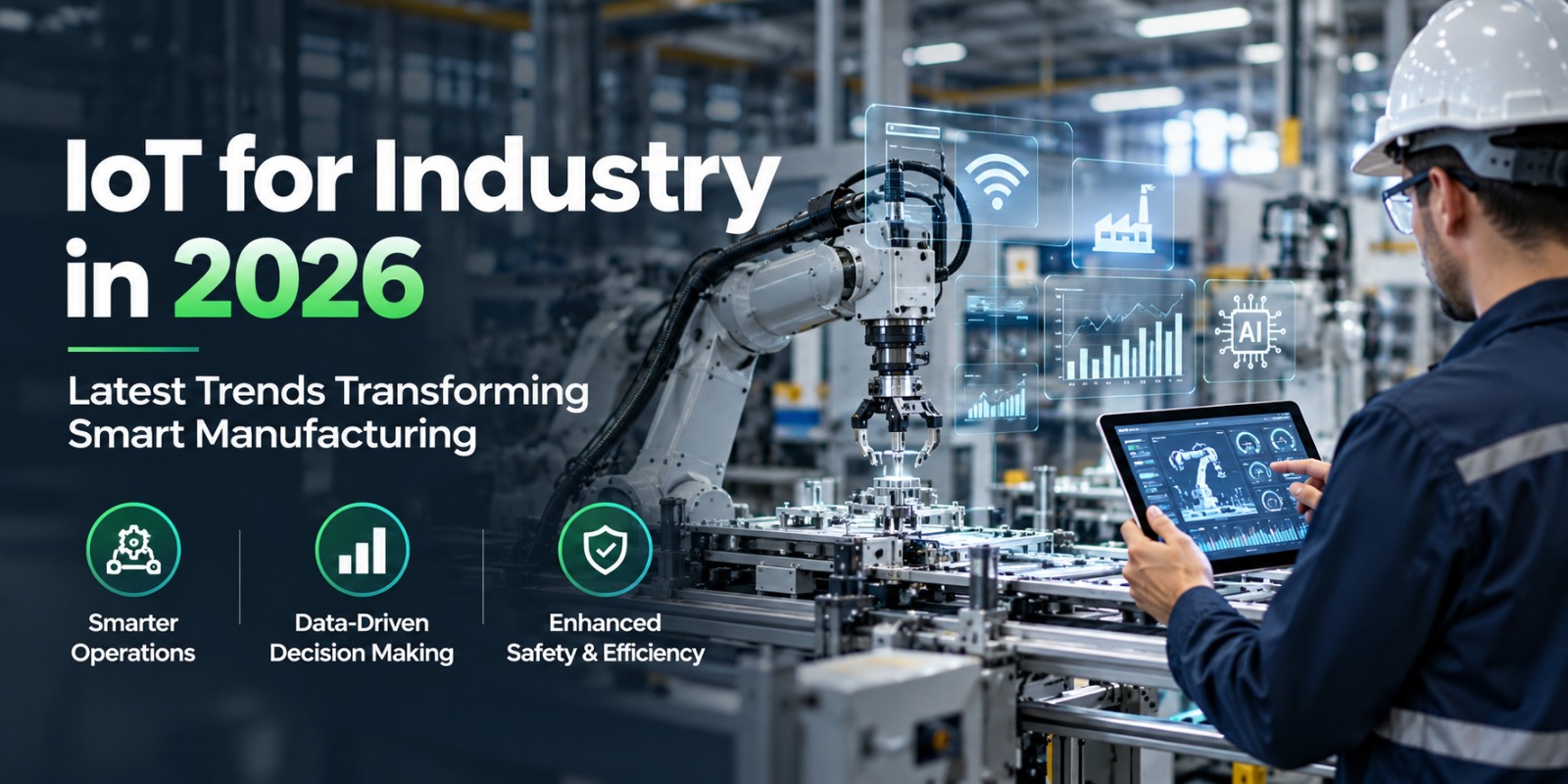
Manufacturing is becoming more connected, data-driven, and responsive. Sensors can monitor machine temperature, vibration, energy consumption, and production status, while digital dashboards help teams identify problems before they interrupt operations. In 2026, the focus is not simply on adopting new technology but on using reliable data to improve efficiency, reduce waste, and support better decisions. IoT for Industry is helping manufacturers connect equipment, people, and digital systems to build smarter, more responsive factories.
What Is Industrial IoT and How Does It Work?
The Industrial Internet of Things (IIoT) connects machines, sensors, controllers, and software to collect and exchange operational data. Sensors measure physical conditions, gateways transmit information, and edge or cloud platforms process readings for monitoring and analysis.
For example, a sensor attached to a motor can detect unusual vibration. A monitoring system can alert the maintenance team, allowing technicians to investigate before a minor issue becomes a major breakdown.
The real value comes from turning these readings into actionable insights. Accurate data, meaningful alerts, and clearly defined responsibilities help manufacturers move from reactive maintenance towards more informed operational planning.
Latest Trends Transforming Smart Manufacturing in 2026
1. AI-powered predictive maintenance
Traditional maintenance often relies on fixed schedules or repairs after a machine fails. Predictive maintenance uses equipment-condition data to identify unusual patterns and support timely inspections.
Temperature, vibration, pressure and power-consumption readings can help technicians recognise early signs of wear. Analytical models may improve predictions, but maintenance professionals should validate alerts against actual operating conditions.
2. Edge computing for faster decisions
Sending every sensor reading to a remote cloud platform may introduce delays or depend on continuous connectivity. Edge computing processes selected information close to the equipment, supporting faster monitoring and time-sensitive decisions.
Cloud systems remain useful for long-term reporting and analysis across multiple facilities. Combining edge and cloud computing allows manufacturers to balance responsiveness, connectivity, and data-management requirements.
3. Digital twins and production visibility
A digital twin is a digital representation of a physical asset, machine, or process that can be updated with operational data. Manufacturers can use these models to explore production scenarios, identify bottlenecks, and compare expected performance with actual results.
However, digital twins are most useful when built around a clear business objective. Reliable information and a defined use case matter more than visual complexity alone.
4. Connected sensors and energy monitoring
IoT for industry applications can help manufacturers monitor equipment status, environmental conditions, energy consumption, and production performance. Comparing readings across machines or shifts may reveal excessive energy use, idle equipment, or inefficient processes.
For example, a factory could compare energy consumption per production batch to identify where further investigation is needed. Consistent measurements help teams distinguish genuine improvements from normal operating variations.
5. Industrial cybersecurity
Connected factories need security measures that protect equipment, production data, and operational systems. Integrating information technology with operational technology can improve visibility, but it also creates additional security risks.
Manufacturers should maintain an inventory of connected devices, restrict user permissions, apply updates safely, segment networks, and monitor suspicious activity. NIST’s manufacturing cybersecurity guidance recommends risk-based safeguards, including authentication, access controls, and integrity monitoring.
6. Integration with existing machinery
Many manufacturers cannot replace every legacy machine at once. Compatible sensors, gateways, and interfaces can help connect selected equipment to modern monitoring platforms.
Before implementation, businesses should check communication protocols, data formats, equipment compatibility, and safety requirements. A phased approach can reduce disruption while allowing teams to test performance before expanding the system.
Benefits of Connected Manufacturing
A well-planned IoT for industry strategy can support measurable operational improvements:
-
Reduced downtime: Condition monitoring helps maintenance teams investigate potential equipment problems earlier.
-
Better production visibility: Supervisors can review machine status, output, and downtime across different shifts.
-
Improved quality control: Process data can reveal conditions associated with defects or inconsistent production.
-
Energy efficiency: Monitoring helps identify where energy is being consumed and where improvements may be possible.
-
Smarter planning: Historical readings support maintenance schedules, capacity planning, and root-cause analysis.
The results depend on equipment, data quality, and how effectively employees respond to the information. Manufacturers should establish a baseline, such as downtime hours or energy consumption per unit, before measuring the impact of a new system.
How AI and Industrial IoT Work Together
Connected devices collect measurements, while analytical tools help interpret them. Machine-learning models can identify unusual patterns, estimate equipment failure risks and flag changes in production behaviour.
Artificial intelligence solutions can support these applications when suitable data, reliable validation methods, and qualified personnel are available. However, AI should not replace engineering judgement, particularly where safety and production continuity are involved.
Manufacturers should test predictions against historical and live data, document limitations, and involve human decision-makers in critical processes. Artificial intelligence solutions deliver greater practical value when they address a clearly defined operational challenge, and their results can be measured.
Challenges and How to Address Them
Common implementation barriers include integration costs, inconsistent data, cybersecurity risks, limited technical skills, and uncertainty about return on investment.
Businesses can reduce these risks by following a structured process:
-
Select one production line or critical machine for an initial pilot.
-
Define the operational problem and establish baseline measurements.
-
Check sensor accuracy, connectivity, and compatibility with existing systems.
-
Set clear rules for data access, ownership, retention, and security.
-
Train operators and maintenance teams to interpret alerts.
-
Review the pilot results before expanding to other equipment or facilities.
This approach helps manufacturers understand the practical value of connected technology before committing to a larger investment.
How to Choose the Right Industrial IoT Solution
Before selecting a platform or technology partner, evaluate:
-
Business objectives: Does the solution address a specific production or maintenance problem?
-
Compatibility: Can it integrate with existing machines and software?
-
Scalability: Can it support additional equipment or facilities later?
-
Security: Are access controls, device management, and data protection addressed?
-
Reporting: Can teams easily understand the information and act on it?
-
Support: Are implementation, maintenance, and training arrangements clearly defined?
-
Total cost: Have installation, connectivity, integration, and ongoing support costs been considered?
IoT for Industry projects should be evaluated against these practical requirements rather than the number of features a vendor advertises. Request a demonstration based on a relevant use case and confirm which capabilities are included, optional, or dependent on third-party services.
For businesses exploring connected industrial technologies, ADRTech India can be a starting point for reviewing relevant technology offerings. Confirm product capabilities, integration requirements, and support arrangements directly before making a purchasing decision.
The Future of Smart Manufacturing
Beyond 2026, connected devices, edge analytics, digital twins, and AI-assisted maintenance are likely to continue evolving. Their success will depend on reliable measurements, secure integration, clear accountability, and employees who know how to use the information effectively.
Manufacturers do not need to digitise every process at once. Starting with a measurable problem, testing a focused solution and expanding after reviewing the results can create a more sustainable path towards smarter operations.
Conclusion
Smart manufacturing is not simply about connecting more machines. It is about using trustworthy data to make timely decisions, reduce avoidable disruption, and improve resource utilization. Businesses should begin with a clear operational objective, protect connected systems, and measure outcomes before scaling their projects.
Explore relevant industrial technology offerings from ADRTech India and confirm that each solution meets your factory’s requirements before implementation.
FAQs – IoT for Industry in 2026
1. What is IoT for industry?
IoT for Industry refers to connected sensors, machines, and industrial systems that collect and exchange data to improve manufacturing operations, equipment monitoring, and production efficiency.
2. How does IoT for Industry improve smart manufacturing?
IoT for Industry helps manufacturers monitor machine performance in real time, identify potential faults, track energy consumption, and make better decisions using operational data.
3. What are the latest IoT trends in industrial manufacturing in 2026?
Key trends include AI-powered predictive maintenance, edge computing, digital twins, real-time sensor monitoring, industrial cybersecurity, energy optimisation, and integration with legacy equipment.
4. How does AI work with Industrial IoT?
AI analyses data collected from connected industrial devices to identify patterns, detect anomalies, forecast equipment failures, and support production planning.
5. What are the main benefits of implementing Industrial IoT?
The main benefits include improved equipment visibility, reduced unplanned downtime, better quality control, more efficient energy use, and data-driven operational decisions.