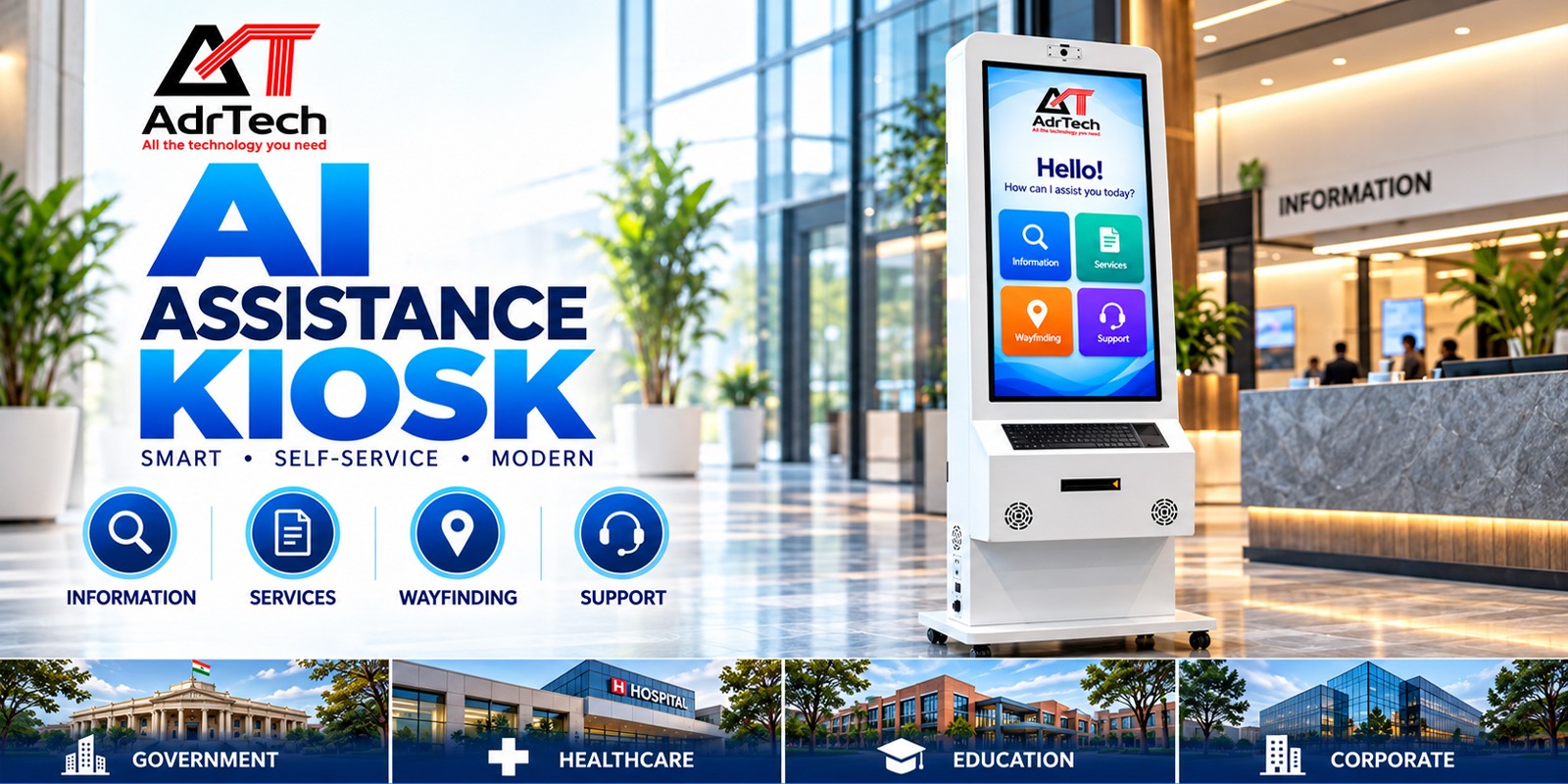
Across India, many organizations are looking into better means to serve customers and visitors. The AI assistance information kiosks are fast becoming a convenient means to give out information at speed. Whether it is helping patients get through the departments in a hospital or guiding visitors within the corporate office premises and the shopping mall, the AI Assistance Information Kiosk can help with routine inquiries and providing information. How it does so depends upon the type of technology and software employed.
What Is an AI-Powered Information Kiosk?
An AI-powered information kiosk is a device that assists in searching for information. An example of a basic AI-powered information kiosk would be a terminal that displays directories, menus, or asks questions. An advanced AI-powered information kiosk allows visitors to ask questions via keyboard or voice and receive answers based on verified information.
Some AI-powered information kiosks can even connect to maps, appointment booking services, visitor management software, or internal databases.
Having the word “AI” in the description of a product does not mean that all AI-powered information kiosks have the ability to perform all tasks.
The voice interaction capability, language support, personalization and interconnections with other services depend on the hardware, software, data used, and configuration performed.
It is essential to review those features at the demonstration stage rather than to assume they are already there by default.
Key Features to Consider
Interactive touchscreen navigation
A properly designed interface helps the user go through different categories, find the required department, and get information on services or directions. Large buttons, readable text, and intuitive menu navigation help people who have never used it before.
Conversational assistance and FAQs
If the bot is installed, it answers the visitor’s question using natural language rather than making them choose among several predefined options. This information must be drawn from authorized sources such as information on the service offered, working hours, directories, and policies. The user will be notified in case it is unable to provide the answer.
Multilingual and voice options
In cases where one requires catering to the linguistic diversity of a traveller from a multilingual country, the language selection may come in handy in assisting to meet the needs of the traveler in Hindi or another local language. Voice commands can be handy, provided one has tested them for accents, noise and speech recognition ability.
Directories, wayfinding, and integration
A visitor kiosk may contain floor plans, locations of departments, events, or service desks. In certain circumstances, the visitor kiosk may be connected to a website, CMS, appointment-making facility, or visitor management system. These integration needs should be made known at the early stages to make sure that the kiosk has current information displayed.
Accessibility, privacy and security
The interface should be user-friendly, regardless of the differing digital skill sets of the users. The organization should take into consideration factors such as screen position, readability using colour contrast, session timeout, access control, software updates, and network security. One should collect personal data needed for the intended purpose only.
Major Benefits for Indian Businesses
A properly developed AI assistance information kiosk can provide an opportunity for users to receive routine information while saving the time of the staff answering repeated questions. Based on the purposes, the users can use the kiosk to search for information regarding directions to departments, instructions on the services, etc.
One more possible benefit of an AI Assistance Information Kiosk is the consistency of the information provided. If the information is obtained from the appropriate source containing pre-approved information, then the visitors can receive consistent information at different shifts and different places. If the privacy rules permit, the organisation may analyse the patterns of requests from visitors and identify problems, such as ambiguous signposting, absence of certain information on the website, etc.
However, the AI Assistance Information Kiosk cannot replace human contact. The complex complaints, sensitive issues, special cases, and decision-making requiring professional judgments should be referred to the respective employees.
Applications Across India
Hospitals and healthcare facilities
An AI assistance information kiosk in a hospital will assist in guiding the visitors to the relevant departments, diagnostic centers, billing counters, visiting hour information, and other directions. They might also offer help regarding appointments, provided that the system that they are working on is verified. Medical assistance, diagnosis, and emergency triage are out of the scope of such a system unless there is a valid and properly governed system in place.
Colleges and universities
Information regarding admissions, locations of various departments, examination schedules, events schedule and information regarding other services of the campus can be presented on an information kiosk. Such kiosks would be helpful especially for first-time visitors of the educational campus.
Corporate offices and IT parks
Interactive kiosks in office lobbies can be used for providing building directory, locating rooms for meetings, providing instructions to the visitors, and other information related to the company. In case of mandatory registration, identity verification and privacy concerns should be considered separately.
Retail, malls and hospitality
Stores can use directory boards, promotional information, service desk locations, and event information. Hotels can use information about their facilities, amenity locations, and frequently asked questions by guests. Any information about booking, payments or loyalty accounts can only be provided if such features are indeed available.
Government and public service locations
Office kiosks may use directories to show where different services are provided, what documents are necessary based on official recommendations, and direct users to the appropriate desk. The information needs to be verified against official resources, and cannot be used as a replacement for an official decision or authorization.
AI Kiosk vs Traditional Information Kiosk
A conventional kiosk is dependent on a fixed menu, directory searches, or pre-written pages. The system is reliable and cost-effective when a small amount of predictable pieces of information is needed by the visitor. However, the use of an AI kiosk may provide flexibility to pose queries but would necessitate some extra efforts for preparation, governance, testing, and monitoring.
The decision whether to opt for the AI Assistance Information Kiosk or not must be based on the types of questions posed by visitors, frequency of updates to the information, requirement for multiple languages, integration, and budget available for support. Mapping out the common actions of visitors must precede the use of AI.
How to Choose the Right Solution
Use this checklist when evaluating digital kiosks:
- Define the primary objective and users for whom the kiosk will operate.
- Identify typical questions and ensure that accurate answers to those questions are available.
- Evaluate screen size, positioning, sturdiness, accessibility, and operating environment.
- Evaluate languages, voice, and artificial intelligence functionality with a demonstration.
- Verify integrations, content update responsibility, security provisions, and privacy needs.
- Analyse warranties, installations, maintenance, software expenses, and post-sale support.
- Test the product with end users and analyse task completion rate, unanswered questions, and user feedback..
Inquire about the supplier’s approach to handling inaccurate answers, the content updating process, and the connection breakdown. Focus on total cost of ownership, not just the cost of equipment. A pilot implementation in one location can help uncover potential problems before the broader deployment.
The Future of AI-Powered Information Kiosks in India
Some other possible advancements could be conversational AI interfaces, regional language capability, enhanced connectivity with digital services, and analysis tools to comprehend the need for information. For progress, it is important to have access to accurate data, good design, proper privacy protection, and quality of integration. Each AI capability must be evaluated against a user need and not just the technology itself.
Conclusion
Given the right kiosk, information will become easily accessible and help the visitors and resolve all the issues faced by them. Start with identifying the common questions asked by people and make sure that the answers are provided accurately. Any company that wants digital kiosks can contact ADRTech India.
Frequently Asked Questions
What is an AI information kiosk?
An AI information kiosk is an electronic device that allows people to access information with the help of a touchscreen interface and sometimes speech-based technology. It can display directories and answer frequently asked questions for visitors in a proper way.
In what places can AI information kiosks be implemented in India?
AI information kiosks can be helpful in hospitals, colleges, office spaces, shopping malls, hotels, and places that provide public services. The usual applications include guidance, information about departments, visiting instructions, and answers to FAQs.
What criteria must businesses consider when purchasing an AI information kiosk?
Businesses need to ensure that the following features are included: screen size, accessibility, languages supported, voice or chatbot support, updating capabilities, integration with systems, security measures, warranty, and maintenance. They should ask for a demo of the device.
Can an information kiosk with AI take the place of receptionists?
Not necessarily. The AI kiosk could be helpful for routine inquiries and directions; however, employees are still needed for more complicated issues and situations. Make sure that there is a way for guests to connect with one of your employees.
How can businesses ensure kiosk information is up to date?
Companies need to appoint someone responsible for reviewing the information, making sure the links work and checking whether the services are still available. Also, there should be a system to track unanswered questions.